

Applying mastery-based learning in tech-ed: Part 1
In a first principles approach to education system design, mastery-based learning would be among the first of the principles.

The primary mechanism of Mastery-Based Learning (MBL) is this: learners must demonstrate a certain skill level on a specific learning task before being allowed to move to the next step. If a learner is struggling with a task, they get additional support. If someone finishes a task early, they are given extra “enrichment” activities to keep them engaged and busy.
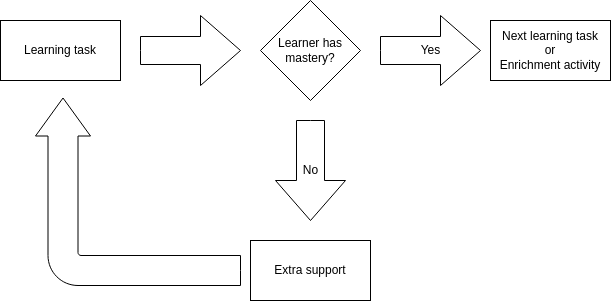
MBL is very different from how classrooms typically work in traditional education systems: learners are typically given the same lessons at the same pace.
In this article, I’ll discuss the benefits and mechanisms of MBL and how MBL can be applied in code schools. Of course, lessons here are also relevant outside of code schools, but code schools are my thang.
Normal distributions
In a cohort-paced learning environment, education moves at a set pace. Learners’ learning paces tend to follow a normal distribution:
Some learners are slower than the average pace - many would assume this is because they have lower aptitude, but that’s a bit reductionistic. Maybe someone is moving slowly because they have problems at home, health issues, or any number of other things.
Other learners are capable of moving faster than the average pace. These learners might pursue something constructive in their free time, chill, or get into trouble. Personally, I can say I was bored to tears at school and probably could have benefited from being pushed to do a bit more
Then there are the average learners moving at the average pace. If the learning tasks are paced out so that the average learner keeps pace, then these learners will do just fine. But deciding on how quickly people should work and tuning the education tasks and pace to match the pace of any learner or group of learners is non-trivial. The best way to ensure the success of the greatest number of learners is to be conservative about what a course can cover in a given period. In other words, move slowly. Move slightly slower than the average learner
This is clearly sub-optimal.
On the other hand MBL deals with these groups of learners in a totally different way: The learners who are slower than the rest get the time and the TLC they need to master the material before moving forward, and the speedy folks get to crush it.
If you remove a major reason for failure, fewer people fail.
Benefits
Studies show that mastery-based learning offers many benefits for learners. And if you think about the mechanisms of MBL, then those benefits make intuitive sense.
Why do learners fail at completing courses?
They don’t have enough time to solidify their skills
They need more tlc than the rest of the group
They move forward onto more advanced material despite not mastering the prerequisite fundamental skills. Advanced knowledge builds upon the basics
MBL solves all of this. In a cohort-paced learning environment, a learner’s likelihood of success strongly correlates with the learner’s natural pace of learning. MBL breaks this dependency.
Here are a few reported benefits of mastery-based learning over more traditional cohort-paced classroom setups, as well as some explanations for them:
Learners are often more satisfied with the instruction they receive. This makes sense because learners would only receive instruction when they need it and only what they need. They wouldn’t be pushed to try to grasp content they aren’t ready for, and they wouldn’t be forced to accept instruction on things they don’t need help with. If they needed extra assistance to move forward, then that is what they would get.
Learners display aspects of a growth mindset, and an improved academic self-concept. Learners who are required to master a thing before moving forward learn that they can master things. If a learner is forced to move forward when they are not yet ready, then they get set up to struggle and possibly fail completely at advanced concepts. Of course, this is likely to affect their self-concept in a negative way, as those needing support are made helpless by the system. Learned-helplessness is a whole thing].
There is a decreased amount of variability between learner outcomes. This also makes sense if you consider that the slower learners who would usually be forced to keep pace with a larger group would actually be given a chance to make real, solid progress. With enough time, all learners would achieve mastery of all concepts, assuming that instruction is of a high enough quality, and the learners have enough basic aptitude.
Learners are more likely to stay on task. This would make sense because there are tangible benefits to staying on task: Once you finish a task, you can move forward. And for those slower learners, they are less likely to give up and do something else because they are given a chance as well
Advanced concepts become easier to master An example from coding is that a person should master variables before they can master function arguments, and they should master function arguments and returns before they can master things like unit testing, recursion or use of existing libraries and frameworks. Advanced knowledge and skill is built upon mastery of fundamental concepts.
In a perfect education system, each learner would be able to move at their optimal pace, and they would get the help they need as they need it. In a perfect world, learner achievement would not follow a normal distribution based on how quickly they can work.
Here is what happens if you force all learners to move at the same pace:

And this is what happens if you get each learner to move at their optimal pace:

Graphs from: Mastery learning. (2024, January 20). In Wikipedia. https://en.wikipedia.org/wiki/Mastery_learning
Implementation in a code school
If you are teaching a single person to code, or do anything really, it is operationally straightforward to implement MBL. But things get challenging if there is a group of learners.
Firstly, you need a syllabus that lends itself to self-paced consumption. This means the syllabus needs to be in a useful format so learners can go through it as needed. It also needs to be of high quality so that people don’t just trip over content issues and require repeated human assistance.
The next thing you need is assessments. Lots and lots of assessments. One of the big challenges with MBR is the fact that it relies so heavily on people proving their skills at different points.
After that, you need some learners who are motivated to move at a reasonable pace, mechanisms for seeing who needs help, mechanisms for tracking the competence of a number of different skills over time...
Sometimes you need to be aware of the diminishing returns of the pursuit of mastery; some “prerequisites” can be discovered by the student later. They should be allowed to build their own knowledge without the educator holding them to excessive standards (in tech, this can lead to cargo culting; foot guns are great teachers).
The rabbit hole goes pretty deep.
To be continued…
In the next article, we’ll be going deeper into some of the challenges MBL introduces to education, and a bit about how to address those.
Want to learn with us?
Prelude offers a variety of technical and soft skills training.
You can see our upcoming public workshops here. We also offer a few configurable training programs for teams, covering both technical and “soft” skills.